The Corner Drugstore Died and Nobody Noticed
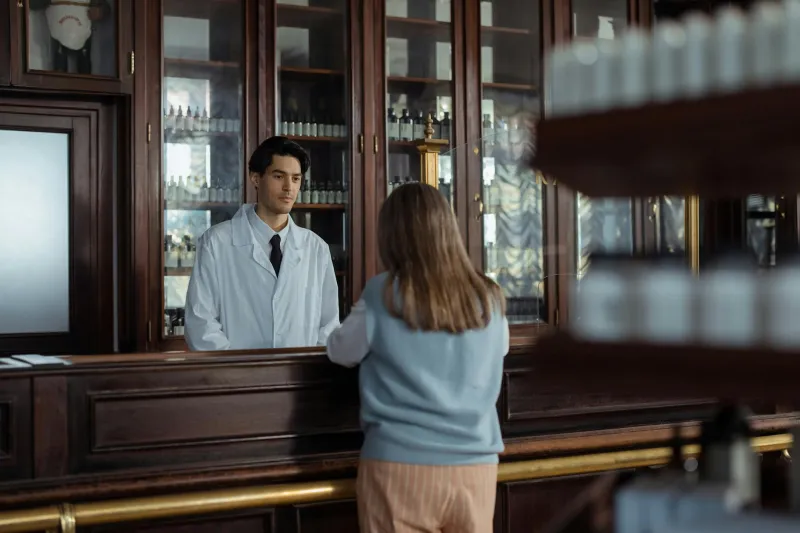
There was a time when the local pharmacy wasn't just a place to pick up medicine. It was a destination. You'd walk in on a Saturday afternoon and find half the neighborhood doing the same thing — not necessarily to fill a prescription, but to exist in that particular space where health and community intersected.
The pharmacist behind the counter wasn't a distant technician processing transactions. He was Mr. Patterson, or Mrs. Chen, or whoever had owned the place for twenty years. He remembered that your mother took her thyroid medication in the morning, that your father had switched blood pressure drugs last spring, that you'd been asking about your kid's persistent cough for three visits now. He'd see you coming and already have your usual waiting, or he'd ask how the medication was working out, or he'd recommend you talk to your doctor about something new he'd just read about.
Downstairs — or in a corner of the same room — sat the soda fountain. This wasn't a novelty. It was the heart of the operation. You'd sit on a vinyl stool and order a cherry coke while your prescription was being filled, watching the pharmacist work through the window. Families came here. Teenagers came here. It was casual, accessible, and utterly normal.
When Convenience Swallowed Everything
Then the chains arrived.
CVS, Walgreens, and Rite Aid didn't destroy the corner pharmacy overnight. They did something slower and more efficient: they made it irrelevant. A CVS opened three blocks away with longer hours, more products, and the promise of one-stop shopping. Then another opened two miles in the opposite direction. The economics were ruthless. Why drive to Patterson's when you could hit a chain pharmacy while grabbing milk and greeting cards?
The corner pharmacies didn't disappear in a single wave. They closed gradually, one by one, their departure marked by a hastily printed sign taped to the door and a forwarding notice. Some lasted into the 1990s. A few stubborn independents held on into the 2000s. But by then, the transformation was complete. The pharmacy had become a department — a small counter in the back of a fluorescent-lit box store, staffed by people who'd never see you twice.
The soda fountains were already gone. They'd vanished in the 1970s and 80s, casualties of changing consumer habits and the rise of fast-food chains. The pharmacy had lost its social function first; the loss of the drugstore itself just formalized what had already happened.
The Impersonal Efficiency Era
For three decades, this felt like progress. The chain pharmacies were efficient. They were open late. They had everything. You could fill your prescription and buy a greeting card and pick up milk without leaving the parking lot. The experience was standardized, predictable, and free of the quirky inefficiencies of small-town retail.
What we didn't calculate was the cost of that efficiency. The pharmacist at CVS didn't know you. They were processing 300 prescriptions a day, often understaffed, often frustrated. The interaction was transactional. You handed over your insurance card, paid your copay, and left. There was no conversation about side effects, no gentle reminder to take your medication with food, no casual mention of a new drug that might work better for your condition.
The pharmacy became what it had never been before: invisible. You went there because you had to, not because you wanted to.
The Sudden Disappearance
Then something unexpected happened. The chains started closing too.
Walgreens announced in 2022 that it would shutter 1,200 stores over three years. CVS closed hundreds of locations. Rite Aid filed for bankruptcy in 2023 and began liquidating stores across the country. The news came suddenly, but the underlying problem had been building for years: the economics of retail pharmacy had fundamentally changed.
Online pharmacies and mail-order prescriptions had eaten into foot traffic. Labor costs had risen. The margins on prescriptions — the core business — had been compressed by insurance companies and pharmacy benefit managers. The stores that had replaced the corner pharmacy were themselves becoming unviable.
What emerged was something new and strange: pharmacy deserts. Entire neighborhoods, particularly in rural areas and low-income urban communities, suddenly had no nearby pharmacy at all. The New England Journal of Medicine reported that between 2015 and 2021, nearly 1,000 retail pharmacy locations closed in the United States. The people most dependent on local pharmacies — the elderly, the poor, those without reliable transportation — were hit hardest.
But here's what's remarkable: most Americans didn't notice until their own local pharmacy closed.
What We Lost Without Watching
The disappearance of the neighborhood pharmacy represents something larger than the loss of a retail location. It's the vanishing of a particular kind of healthcare relationship — one built on familiarity, trust, and sustained human contact.
A pharmacist who knows your medical history can catch dangerous drug interactions. They can notice when you're getting refills too frequently or not frequently enough. They can offer advice that's specific to you, not generic. They can advocate for you when dealing with insurance companies. They can be a first line of defense for health problems that don't quite warrant a doctor's visit.
Chain pharmacies tried to provide this service, but the model was broken from the start. You can't build meaningful healthcare relationships in a system designed to process transactions at maximum speed.
And now, as the chains themselves vanish, we're learning what we traded away: not just convenience, but a kind of healthcare safety net that existed at the community level. We accepted the chain pharmacy's efficiency without realizing we were signing away something irreplaceable.
The corner drugstore didn't just disappear. It was replaced, and then its replacement was replaced, and now we're left wondering where the pharmacy actually is. The answer, increasingly, is nowhere nearby. And that realization — when it finally comes — might be the moment we notice what we lost.