From Doorstep Adventures to Safety Theater: How Halloween Lost Its Magic
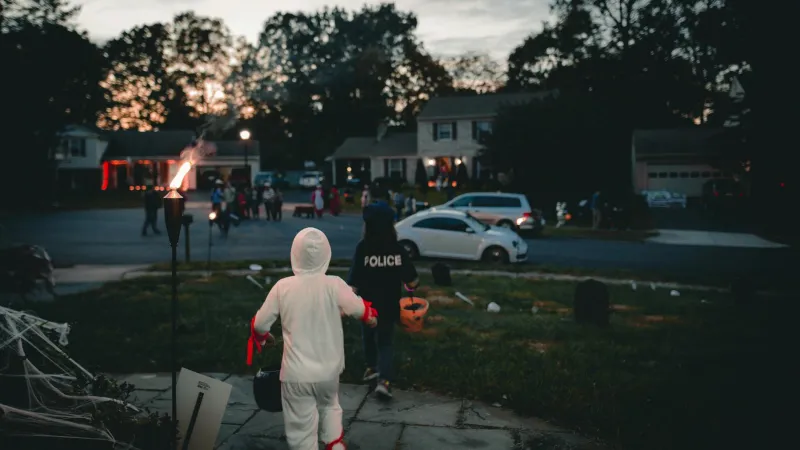
Picture this: It's October 31st, 1975. The streetlights are just flickering on as groups of costumed kids burst from front doors across America, armed with pillowcases and a simple mission — collect as much candy as humanly possible before parents start calling them home. No GPS tracking, no scheduled routes, no trunk-or-treat alternatives. Just hundreds of little ghosts and goblins disappearing into the autumn darkness for hours of unsupervised adventure.
That Halloween — wild, unscripted, and gloriously chaotic — is as extinct as the dinosaurs.
When Halloween Belonged to the Kids
In the decades before stranger-danger paranoia rewrote the rules of childhood, Halloween was America's one night of sanctioned anarchy. Kids as young as six roamed neighborhoods in packs, knocking on doors of people they'd never met, collecting candy from strangers without a second thought.
The ritual was beautifully simple. You threw on whatever costume your mother cobbled together from old sheets and cardboard, grabbed the biggest bag you could find, and headed out into the night. No adult supervision required. No predetermined route. No safety briefings or emergency contact numbers pinned to your costume.
You knew every house on your block, and most of the ones three blocks over. Mrs. Henderson always gave out full-size Snickers bars. The creepy house on Elm Street had the best decorations but cheap candy. The apartment complex was a goldmine — dozens of doors in one building.
 Photo: Elm Street, via facts.net
Parents stayed home, handing out candy to other people's kids and trusting that their own children would return eventually, sugar-drunk and exhausted but fundamentally safe. Because in 1975 America, that trust still existed.
The Fear Factory Starts Up
The transformation didn't happen overnight. It began in the early 1980s with a few isolated incidents that got blown into national panics by a media machine that had discovered fear sold better than facts.
The "razor blade in the apple" stories became urban legends, despite investigators finding virtually no verified cases of strangers tampering with Halloween candy. The "dangerous stranger" narrative took hold, even though statistics showed kids were far more likely to be hurt by someone they knew than by the nice retired couple handing out Tootsie Rolls three streets over.
But facts couldn't compete with fear. By the late 1980s, local news stations were running "Halloween Safety" segments that treated trick-or-treating like a military operation. Hospitals offered free X-ray services for suspicious candy. Police departments issued warnings about "safe" versus "unsafe" neighborhoods, as if child predators had somehow organized themselves by zip code.
Enter the Safety Industrial Complex
As parental anxiety reached fever pitch, American ingenuity kicked in — not to solve the imaginary problem, but to profit from it. The "safer" alternatives began multiplying like candy corn.
Trunk-or-treat events popped up in church parking lots and school gymnasiums. Instead of wandering neighborhoods and meeting new people, kids now walked in circles around decorated car trunks, collecting pre-approved candy from pre-screened adults. It was Halloween reduced to its most basic transaction — costume for candy — stripped of adventure, mystery, and genuine human connection.
Mall trick-or-treating became the ultimate sanitized experience. Climate-controlled, security-monitored, and completely artificial. Kids walked from Spencer's to Orange Julius collecting candy from teenage employees who'd rather be anywhere else.
Meanwhile, actual trick-or-treating became increasingly regimented. Parents began accompanying children who previous generations would have considered old enough to drive. Predetermined routes replaced spontaneous exploration. Text message check-ins every thirty minutes. Reflective tape on costumes. Flashlights mandatory.
When Community Became Commodity
The most tragic casualty of Halloween's transformation wasn't just childhood independence — it was community connection. The old Halloween forced interactions between neighbors who might otherwise never speak. Kids learned that most strangers were actually pretty nice people who were excited to see their costumes and hear about their night.
Mrs. Chen would always ask about school. Mr. Rodriguez kept a Polaroid camera to take pictures of the best costumes. The college students in the rental house might be eating pizza in their bathrobes, but they'd still dig around for loose change and Life Savers to contribute to the cause.
These weren't just candy transactions — they were tiny community building exercises repeated thousands of times across America every October 31st. Kids learned that their neighborhood was full of people who cared about them, even if they'd never met before.
The New Halloween Math
Today's Halloween operates on completely different principles. Instead of trust, we have verification. Instead of adventure, we have itineraries. Instead of community, we have controlled environments.
Modern parents plan Halloween like a NASA mission. They research neighborhoods online, check sex offender registries, coordinate with other families via group text, and track their children's movements in real time. The spontaneous joy of discovering a house with amazing decorations has been replaced by Yelp reviews of the "best trick-or-treating streets."
Kids arrive at houses in SUV convoys, accompanied by adults with smartphones recording every interaction. The doorstep conversations that once connected neighbors have been reduced to hurried transactions. "Say thank you, honey. We need to hit twelve more houses before eight o'clock."
What the Numbers Actually Say
Here's the irony: Halloween was never actually dangerous. FBI statistics show that children are no more likely to be victims of crime on October 31st than any other day. The "stranger danger" that reshaped Halloween was largely a media-manufactured crisis.
Meanwhile, the real risks of childhood — obesity, depression, social isolation — have skyrocketed during the same decades we've been "protecting" kids from imaginary Halloween predators. We solved a problem that didn't exist and created new ones that definitely do.
The Ghost of Halloween Past
Somewhere between protecting our children and controlling their experiences, we forgot what Halloween was actually supposed to teach them: that the world is full of surprises, that most people are fundamentally good, and that a little bit of risk makes life worth living.
The old Halloween produced generations of Americans who learned to navigate the world with confidence, who understood that community meant looking out for each other's kids, who discovered that adventure and safety weren't mutually exclusive.
Today's version produces kids who are experts at following predetermined routes but have never learned to find their own way home.
Before the blink, Halloween belonged to the kids. After the blink, it became another item on the parental anxiety checklist. We traded magic for management, and everybody lost.