Steel Slides and Broken Bones: How We Traded Adventure for Anxiety
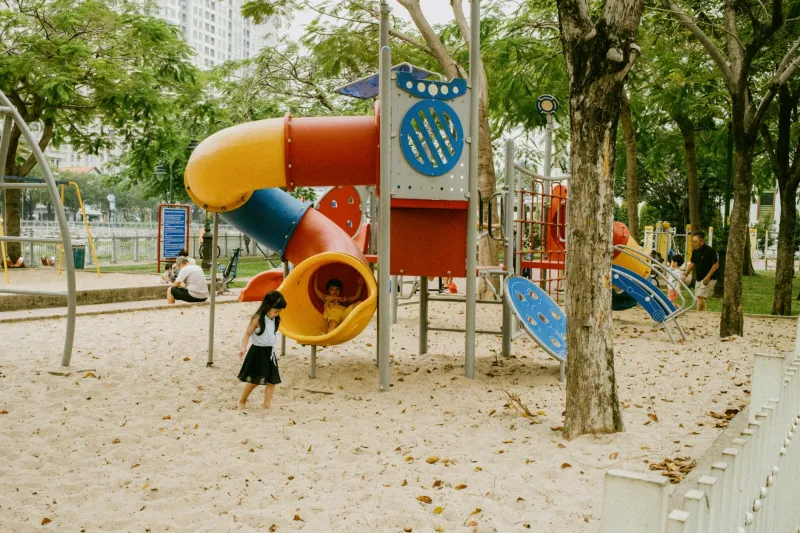
The metal slide at Lincoln Elementary stood twelve feet tall and faced due south. By noon on any summer day, it was hot enough to leave marks. Kids knew this. They also knew that if you went down wearing shorts, you'd get burned. If you went down in jeans, you'd fly off the end and hit the asphalt hard. The solution? Wait for clouds, bring a towel, or just accept that playground glory sometimes came with a price.
 Photo: Lincoln Elementary, via beamprof.com
That slide was demolished in 1994, along with the rest of the playground's original equipment. In its place rose a cheerful collection of rounded plastic structures, rubberized surfaces, and carefully calculated fall zones. No child would ever again burn their legs on superheated metal or crack their head on unforgiving concrete.
They also would never again experience the specific thrill of conquering something genuinely dangerous.
When Playgrounds Were Built Like Obstacle Courses
American playgrounds of the 1960s through 1980s operated on a simple principle: children were small, resilient humans who could figure things out. Equipment designers seemed to ask not "How can we make this safer?" but "How high can we make kids climb?"
The merry-go-round was a perfect example. These weren't the gentle, motorized carousels of today's playgrounds. They were heavy metal discs that required serious coordination to mount while spinning. Kids would grab the bars and run alongside, building momentum until the thing was spinning fast enough to generate actual centrifugal force. The weak-gripped got flung off. The strong-gripped held on and experienced something close to G-force.
Jungle gyms stretched fifteen feet into the air with no safety nets beneath. Monkey bars spanned distances that required genuine upper body strength to complete. Seesaws were balanced on fulcrums that could launch a lighter child skyward if their partner jumped off at the wrong moment.
Every piece of equipment was a physics lesson disguised as play. And yes, kids got hurt.
The Great Safety Revolution
The transformation began in the late 1980s when liability lawyers discovered playgrounds. Suddenly, every scraped knee became a potential lawsuit, every broken arm a municipal nightmare. The Consumer Product Safety Commission issued guidelines that read like engineering manuals: fall zones must extend six feet in all directions, surface materials must meet specific impact-absorption standards, and no component could present what regulators called "entrapment hazards."
Insurance companies took notice. Playground manufacturers responded with designs that prioritized legal protection over adventure. Metal gave way to plastic. Sharp angles became rounded curves. Heights dropped from twelve feet to eight, then to six. Concrete and asphalt disappeared beneath layers of rubber mulch and foam padding.
By the late 1990s, the typical American playground looked like a colorful medical device designed by committees of lawyers.
What We Lost When We Eliminated Risk
Developmental psychologists now have decades of research on what happens when children grow up without calculated physical risk. The results are troubling. Kids who never navigate genuine physical challenges often struggle with risk assessment later in life. They either become paralyzed by minor uncertainties or make catastrophically poor decisions when real danger appears.
Dr. Peter Gray, a research professor at Boston College, has studied what he calls "risky play" for over two decades. His findings suggest that children who climb high, move fast, and occasionally get hurt develop better spatial reasoning, improved emotional regulation, and stronger problem-solving skills than their over-protected peers.
 Photo: Boston College, via www.bc.edu
"When we removed all the risk from playgrounds," Gray explains, "we didn't just make them safer. We made them less educational."
The old playground taught lessons that couldn't be learned anywhere else. That metal slide didn't just burn your legs—it taught you to think ahead, to problem-solve, to weigh risk against reward. The spinning merry-go-round didn't just fling kids off—it taught physics, teamwork, and the importance of holding on when things got difficult.
The Anxiety Generation
Today's children are statistically safer than any generation in human history. They're also more anxious, more depressed, and less physically capable than their parents were at the same age. Emergency room visits for playground injuries have dropped by 50% since 1990. But anxiety disorders among children have increased by 40%.
The connection isn't coincidental. When children never experience manageable physical challenges, they never develop confidence in their ability to handle unexpected situations. A generation that grew up conquering twelve-foot jungle gyms approaches adult problems differently than one raised on padded play structures with maximum heights of six feet.
The Search for Acceptable Adventure
Some communities are beginning to recognize what was lost. "Adventure playgrounds" featuring loose parts, building materials, and calculated risks are appearing in cities like New York and San Francisco. These spaces acknowledge that children need opportunities to test their limits, make mistakes, and occasionally get hurt in order to develop properly.
 Photo: San Francisco, via 2.bp.blogspot.com
But these experiments remain rare, expensive, and heavily supervised. They're conscious attempts to recreate something that once happened naturally in every neighborhood.
Before the Lawyers Arrived
The old playground wasn't perfect. Kids did get seriously injured sometimes, and those injuries were genuinely traumatic for families. But the solution we chose—eliminating all risk rather than managing it—may have created different problems that we're only now beginning to understand.
Before the blink of regulatory reform, American children learned courage on metal slides and developed resilience on spinning merry-go-rounds. They discovered their physical limits through trial and error, not through safety guidelines. They came home dirty, bruised, and confident.
Today's playgrounds are undeniably safer. Whether they're better places to grow up remains an open question.