The Mall Was Our Internet: A Eulogy for the Way America Used to Shop
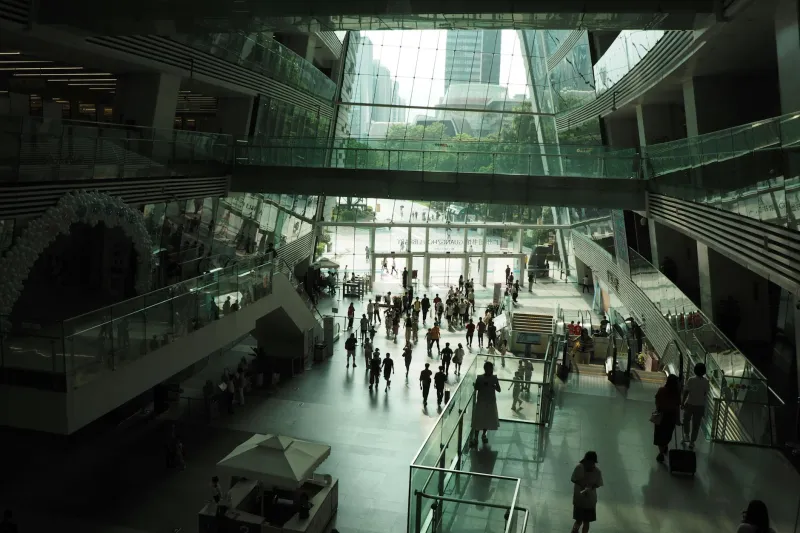
Saturday Had a Smell
It hit you the moment the automatic doors slid open — a specific, unmistakable blend of soft pretzel grease, department store perfume, and whatever candle shop was burning something seasonal near the food court. If you grew up in America between 1980 and 2000, you know exactly what that smelled like. You can probably picture the floor tiles.
The shopping mall, at its peak, wasn't really about shopping. Not entirely. It was the closest thing suburban America had to a town square — a climate-controlled, fluorescent-lit commons where you could kill three hours on a Saturday without spending a single dollar. You'd wander into Spencer Gifts just to look at things you'd never buy. You'd sit on a bench near the fountain and watch people. You'd run into someone from school and stand there talking for forty-five minutes without it being weird.
That world didn't just change. It essentially disappeared. And most of us barely noticed it go.
When the Mall Was the Center of Everything
At its height in the early 1990s, there were roughly 1,500 enclosed shopping malls operating across the United States. They weren't evenly distributed — they clustered around suburbs, anchored by department stores like Sears, JCPenney, and Macy's, with hundreds of specialty retailers filling the corridors in between. The logic was simple and effective: put everything under one roof, give people a reason to stay, and they'll spend money while they're at it.
And they did. But they also did something else. They lived there, in a way. Teenagers used the mall as an after-school hangout. Parents brought young kids to ride the carousel and eat Sbarro. Older adults walked the corridors for exercise before stores opened. The mall served functions that had nothing to do with commerce — it was entertainment, socialization, and something to do when there was nothing else to do.
Browsing was the whole point. You didn't go to the mall knowing exactly what you needed. You went to see. Discovery was built into the experience. You'd walk past a store window, something would catch your eye, and twenty minutes later you'd be trying on a jacket you hadn't planned on buying. Retail was tactile, spontaneous, and occasionally irrational in the best possible way.
The Slow Disappearance
The decline didn't happen overnight, and it didn't happen for just one reason. E-commerce gets most of the blame — and Amazon deserves a significant share of it — but the story is more layered than that. Anchor stores started struggling in the late 1990s as big-box retailers like Walmart and Target drew customers away with lower prices and easier parking. When an anchor closed, foot traffic dropped, and smaller stores followed. The spiral, once it started, was hard to reverse.
By the mid-2010s, the phrase "dead mall" had entered the cultural vocabulary. Photographers documented the empty corridors and shuttered storefronts. Retail analysts coined the term "zombie mall" for properties that were technically still operating but visibly hollowed out. What had once been the commercial heart of a suburb became something between a ruin and a curiosity.
Today, roughly half of the enclosed malls that existed in the 1990s have either closed or been repurposed. Some became warehouses. Some became medical complexes. A few became apartments. A handful are being demolished entirely.
What We Actually Lost
Convenience is the obvious winner in this story. The ability to buy almost anything in a few clicks, have it arrive in two days, and return it without leaving your house is objectively easier than driving to a mall, finding parking, and hoping the store has your size. Nobody's arguing otherwise.
But convenience and experience are different things, and we gave up a lot of the latter in exchange for the former.
What's gone is the friction — and friction, it turns out, had value. The effort of going somewhere created a kind of intentionality. You planned the trip. You spent time there. The experience had weight. Buying something at a mall felt different from buying something online, not because the product was different, but because the act of acquiring it involved your whole day.
There's also the shared-space element, which is harder to quantify but probably more significant. The mall was one of the few places in American suburban life where people of different ages, backgrounds, and incomes occupied the same physical space for the same casual purpose. That kind of informal public gathering — not organized, not ticketed, just people being somewhere together — has become increasingly rare.
Now we shop alone, in silence, on our phones, often late at night. The algorithm shows us what it thinks we want. We click. A box arrives. The transaction is frictionless and forgettable.
Before the Blink
The strange thing about the mall's decline is how quickly it moved from institution to nostalgia. People who grew up in the 1980s and 90s talk about malls the way earlier generations talked about drive-ins or soda fountains — as a thing that defined a particular moment in American life before the moment passed.
It's easy to romanticize it. The mall had real problems: it was a monument to consumerism, it killed independent retail, and it wasn't exactly a model of diverse or equitable public space. But it was something — a place where you showed up without a specific plan and let the afternoon happen.
We traded that for a loading bar and a tracking number. Most days, that trade feels worth it. Occasionally, walking past the empty shell of a former anchor store, you wonder what exactly we were in such a hurry to leave behind.