When Breaking Meant Building: How America Gave Up on Fixing Things
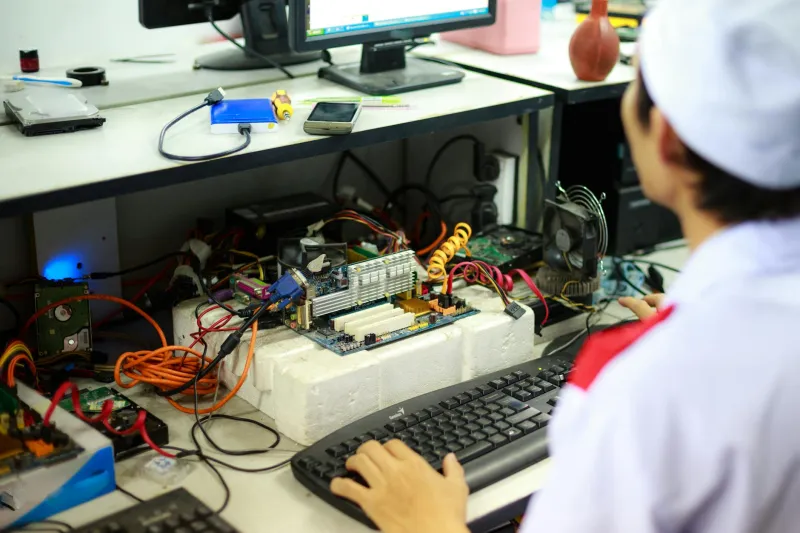
Walk through any American neighborhood built before 1970, and you'll still find them — small storefronts with hand-painted signs reading "TV Repair" or "Radio & Electronics Service." Most are boarded up now, relics of an era when Americans believed broken things were worth saving.
Fifty years ago, when your Zenith television started showing nothing but snow, you didn't drive to Best Buy for a replacement. You unplugged the heavy wooden cabinet, loaded it into your station wagon, and drove to Joe's TV Repair on Main Street. Joe would pop off the back panel, peer into the glowing maze of vacuum tubes, and tell you to come back Thursday. More often than not, he'd have it working like new for the price of a nice dinner.
The Golden Age of the Fix
In 1960s America, repair shops were as common as coffee shops are today. Every town had its electronics wizard, its appliance doctor, its radio surgeon. These weren't just businesses — they were neighborhood institutions. The TV repairman knew your family's viewing habits, remembered which tube your old Philco always burned out, and could diagnose a problem just by listening to the static.
This wasn't sentimentality. It was economics. A decent television cost the equivalent of $3,000 in today's money. When something that expensive broke, you fixed it. Period. The alternative — replacement — was financially absurd for most families.
The repair culture extended far beyond electronics. Americans mended socks, resoled shoes, and rebuilt car engines in their driveways. Sears sold more replacement parts than new appliances. Montgomery Ward's catalog devoted entire sections to vacuum tubes, radio components, and washing machine motors. The assumption was simple: things break, people fix them, life goes on.
The Slow Death of Durability
Somewhere between the moon landing and the personal computer, this relationship began to crumble. The shift wasn't sudden — it was a gradual erosion that most Americans didn't notice until it was complete.
First came planned obsolescence, though manufacturers would never call it that. Engineers began designing products with intentionally limited lifespans. Why build a toaster that lasts thirty years when you can build one that lasts five and sell six times as many? Corporate boardrooms discovered that breaking customers' trust in durability was incredibly profitable.
Then came the economics of scale. As manufacturing moved overseas and automation reduced costs, new products became cheaper than repairs. Why pay $150 to fix a microwave when you could buy a new one for $89? The math was simple, even if the environmental cost wasn't.
Meanwhile, products grew impossibly complex. The television that Joe could fix with basic tools became a computer with a screen — sealed, miniaturized, and filled with components that required specialized equipment to diagnose. The neighborhood repair shop couldn't compete with factory service centers that treated every problem with the same solution: replacement.
When Throwaway Became Normal
By the 1990s, the transformation was complete. "Repair" had become a quaint word, like "icebox" or "party line." Americans learned to think of broken objects the way they thought of spoiled milk — something to be discarded without a second thought.
The numbers tell the story. Today, Americans throw away over 6 billion pounds of electronics annually. The average smartphone is replaced every 2.5 years, not because it stops working, but because something newer exists. We've created a culture where "outdated" and "broken" mean the same thing.
Young Americans have never lived in a world where repair was normal. They've never watched a craftsman bring a beloved object back to life, never experienced the satisfaction of fixing something with their own hands, never learned that most problems have solutions if you're willing to look for them.
What We Lost in Translation
The death of repair culture cost America more than money — it cost us a way of thinking. When we stopped fixing things, we stopped understanding how they worked. When we stopped understanding how things worked, we became consumers instead of owners, renters of our own possessions.
The old repair shops taught patience, problem-solving, and respect for craftsmanship. They connected neighbors and built community around shared problems and solutions. Most importantly, they reinforced a fundamental American belief: that most things worth having are also worth saving.
The Flicker of Hope
Recently, something interesting has started happening. Young Americans are rediscovering repair — not out of necessity, but out of rebellion. Maker spaces, YouTube tutorials, and "Right to Repair" movements are growing. Some have realized that in a world designed to break, knowing how to fix things is a form of freedom.
But these are still islands in an ocean of disposability. For most Americans, the relationship between ownership and understanding has been permanently severed. We live surrounded by mysterious objects that we use but don't comprehend, that we replace but never repair.
Before the blink, Americans fixed what broke. After the blink, we learned to throw it away and buy another one. We told ourselves this was progress, but some days it feels more like surrender.