When Wrong Turns Led to Right Places: How America Lost the Joy of Getting Lost
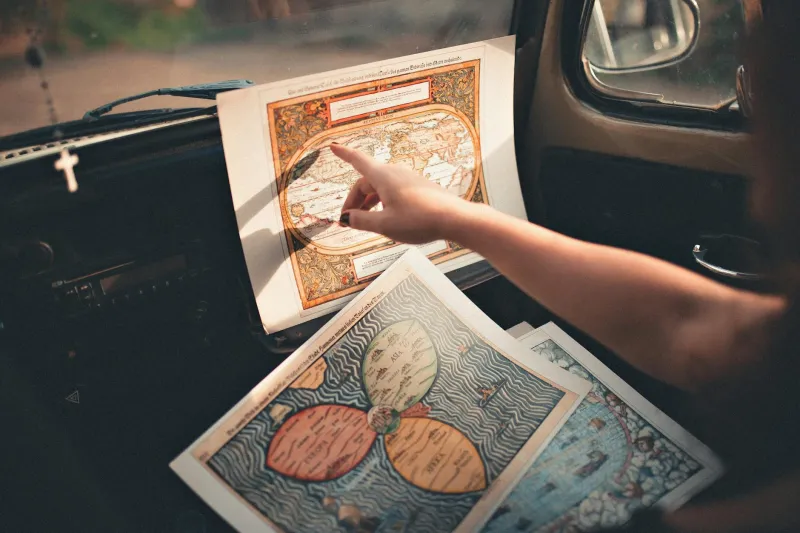
The Last Generation to Fold Maps
There's a particular kind of panic that younger Americans have never experienced: the sinking feeling of realizing you've been driving in the wrong direction for thirty minutes, with nothing but a crumpled gas station map and your own questionable sense of direction to guide you home.
For anyone who learned to drive before the iPhone, getting lost wasn't a technological failure—it was Tuesday. You'd pull over at a Texaco, unfold a map the size of a tablecloth across your hood, and try to figure out where that confident left turn twenty miles back had actually taken you. Sometimes you'd ask the clerk inside, who'd draw directions on the back of a receipt with a Bic pen that barely worked.
When Navigation Was a Social Activity
Getting directions meant talking to strangers. Real conversations with real people who might send you three miles out of your way because they forgot about the bridge construction, or who'd insist their route was better even though it added forty-five minutes to your drive. Gas station attendants became inadvertent travel guides. Locals would lean against your car window, gesturing with their coffee cups: "You can't miss it—just past the red barn, then left at the church."
These interactions created tiny human connections that we didn't even realize we valued until they disappeared. Getting lost forced us to engage with our surroundings and the people in them. Your trip became a story involving characters: the helpful woman at the diner who drew you a detailed map on a napkin, or the teenager at the convenience store who had no idea how to get anywhere but tried to help anyway.
The Art of Dead Reckoning
Before satellites tracked our every move, Americans developed an intuitive relationship with geography. We learned to read landscapes, to notice which way rivers flowed, to remember that mountains were always to the west or that the interstate curved north after the big shopping mall. We navigated by landmarks that mattered to us: the high school where we graduated, the restaurant where we had our first date, the billboard that had been there for decades.
This kind of navigation created a mental map that was uniquely ours. We knew our world through experience rather than algorithms. Getting lost—and finding our way back—built confidence and spatial awareness that GPS has quietly eroded.
Serendipity Had an Address
The most profound difference wasn't the inconvenience of being lost—it was the magic of accidental discovery. Wrong turns led to hidden diners with the best pie in three counties. Taking the "scenic route" (often because you'd missed your exit) meant stumbling onto antique shops, roadside attractions, or viewpoints that weren't in any guidebook.
These unplanned discoveries created the most memorable parts of our trips. The family vacation story wasn't about efficiently reaching your destination—it was about the detour that led you to that amazing ice cream stand, or the time Dad's "shortcut" took you through a town having its annual corn festival.
The Efficiency Revolution
Today's GPS doesn't just prevent you from getting lost—it optimizes away any possibility of inefficiency. Your phone calculates the fastest route in real-time, rerouting you around traffic, construction, and delays you'll never even know existed. It's remarkably effective. It's also remarkably sterile.
We've gained fifteen minutes on every trip and lost something harder to quantify: the sense that travel could surprise us. Modern navigation treats every journey as a problem to be solved rather than an experience to be lived. The destination matters; the journey is just the inconvenient space between where you are and where you want to be.
What We Traded Away
The death of getting lost coincided with the death of several related experiences. We stopped keeping atlases in our glove compartments. We stopped asking for directions. We stopped discovering places by accident. We stopped developing the kind of intimate geographic knowledge that comes from making mistakes and correcting them.
More subtly, we stopped tolerating uncertainty. GPS promised us control over one of travel's last unpredictable elements, and we gladly accepted. But uncertainty had value we didn't fully appreciate. It kept us alert, engaged, and open to possibilities we hadn't planned for.
The Psychology of Knowing
There's a particular confidence that comes from navigating successfully without technology—from reading a map, following your instincts, and arriving where you intended to go through your own skill and attention. GPS has made us all passengers in our own lives, following directions rather than making decisions.
This learned helplessness extends beyond driving. We've become uncomfortable with not knowing, with figuring things out as we go, with the possibility that we might end up somewhere other than where we planned. The tolerance for uncertainty that getting lost required was actually a valuable life skill.
Before the Blink of an Eye
The transition happened so quickly that we barely noticed. One day we were unfolding maps and asking for directions; the next, we were following a calm voice that always knew exactly where we were and exactly where we needed to go. It felt like progress—and in many ways, it was.
But progress always involves trade-offs. We gained efficiency, reliability, and the comfort of always knowing our precise location. We lost serendipity, self-reliance, and the peculiar satisfaction of finding our own way. Whether that trade was worth it depends on what you think travel is supposed to be: a means to an end, or an end in itself.
Somewhere in America, there's probably still a gas station where the clerk will draw you directions on the back of a receipt. But most of us will never need to find it—and that might be the real loss.