Somewhere in a shoebox in your parents' house, or maybe your grandparents', there's an envelope of photographs. The paper is slightly thick. The colors have shifted a little — the blues gone slightly green, the skin tones warm in a way that feels nothing like a filter. Someone wrote a date on the outside in ballpoint pen: July 1986 or Christmas 83 or just Beach.
Open that envelope and you'll find maybe twenty pictures. Twenty. From an entire vacation, or a whole holiday season, or a summer that lasted three months.
That wasn't poverty of experience. That was something else entirely.
The Economics of the Shutter Click
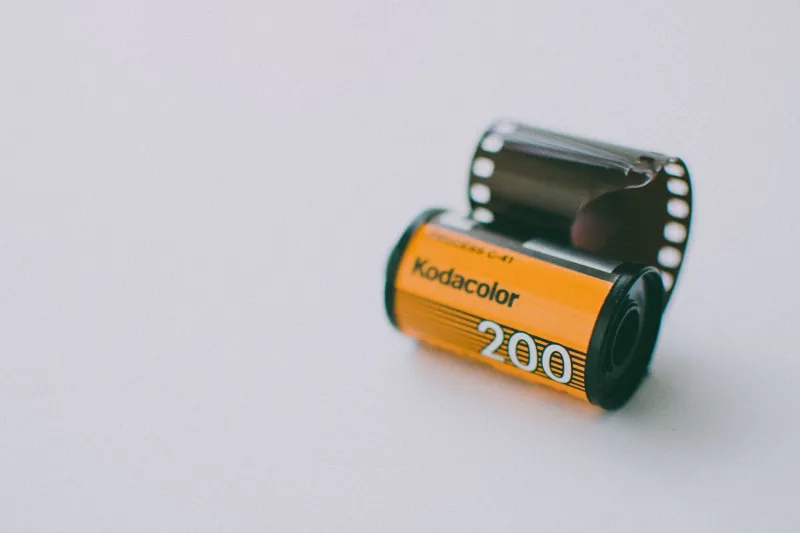
A standard roll of 35mm film gave you twenty-four exposures. Splurge on the longer roll and you got thirty-six. That was it. When the roll was done, you couldn't review what you'd taken, delete the blurry ones, and shoot again. The moment was sealed the second you advanced the film.
And it cost money. In the early 1980s, a roll of Kodak film ran about two dollars — roughly six or seven dollars in today's money. Then you had to pay to develop it. A standard development and print order at a drugstore or a one-hour photo lab might run another five to eight dollars. So every single photograph you took represented a real, tangible investment.
You thought before you shot. You had to.
At a birthday party, you didn't fire off forty frames of the same moment hoping one came out right. You waited. You watched the scene settle into something worth preserving. You made a choice — and then you lived with it, because there was no undo.
The Wait Was Part of the Experience
Here's something the digital generation has never had to feel: the anticipation of not knowing.
You shot a roll of film at your cousin's wedding in June. You didn't drop it off until mid-July when you were finally near a drugstore. The prints weren't ready for another hour, or a few days if you went with the cheaper option. You picked up the envelope, maybe in a parking lot, and you went through those photos right there — in the car, in the summer heat — seeing those moments again for the first time.
Sometimes a shot you thought was ruined turned out perfect. The slightly tilted frame at the reception, the one where everyone was mid-laugh and the light was coming through a window you hadn't even noticed — that one ended up in a frame on the wall for twenty years.
Sometimes the whole roll was a disaster. Underexposed. Blurry. A thumb in the corner of every third shot. You just had to accept that and move on.
The delay between capturing a moment and seeing it created something that doesn't really exist anymore: genuine surprise at your own memories.
What Scarcity Did to Meaning
There's a photograph of my father from 1971, standing in front of a car he'd just bought. He's grinning. He's wearing a short-sleeved plaid shirt. Behind him, the car is parked at a slight angle, like he pulled over specifically for this moment.
One photo. That's all there is from that day.
But because there's only one, it carries everything. You look at it and you actually look at it. The details matter. The expression holds weight.
Now open your camera roll. Scroll back six months. Find a random Tuesday. How many photos did you take? How many do you actually remember taking? How many have you looked at since?
The average iPhone user now has somewhere between 2,000 and 5,000 photos sitting in their camera roll at any given time. Studies have found that this sheer volume actually impairs memory — the act of photographing something so easily, so automatically, reduces the brain's incentive to actually encode the experience. You outsourced the remembering to the device. And then you never looked at the device again.
The Album Was a Curation Decision
Film photography didn't end at the print. It ended at the album.
Somebody — usually a mom, usually on a winter evening — sat down with a stack of photos and made decisions. This one goes in. This one doesn't. These three tell a story together. This one gets a caption written in white ink on black paper.
That process was an act of editorial judgment applied to a life. It said: this moment mattered enough to keep, to arrange, to show someone else.
The photo album was a handmade argument for what your family valued. And you can still read that argument today, forty years later, because someone took the time to make it.
Most of us have no equivalent now. We have cloud storage, technically organized by date, practically organized by nothing. Thousands of images that no one will ever print, arrange, or sit down with on a winter evening.
What We Gained, and What Quietly Slipped Away
None of this is an argument against digital photography. The ability to document your child's first steps in crystal-clear video, to share a moment with someone across the country in seconds, to try and try again until you get it right — these are genuine gifts.
But there's something worth acknowledging in the loss.
Film photography imposed constraints, and those constraints created intention. You couldn't afford to be careless. You couldn't afford to be absent-minded. Every shot asked you to be present — to look at the scene, decide it was worth preserving, and commit.
Twenty-four shots. Make them count.
The people who grew up with that limitation didn't take fewer memories home. They took more deliberate ones. And somewhere in a shoebox, those memories are still waiting — slightly faded, slightly warm, completely irreplaceable.