When a Wrench and a Saturday Were All You Needed: The Slow Death of the Backyard Mechanic
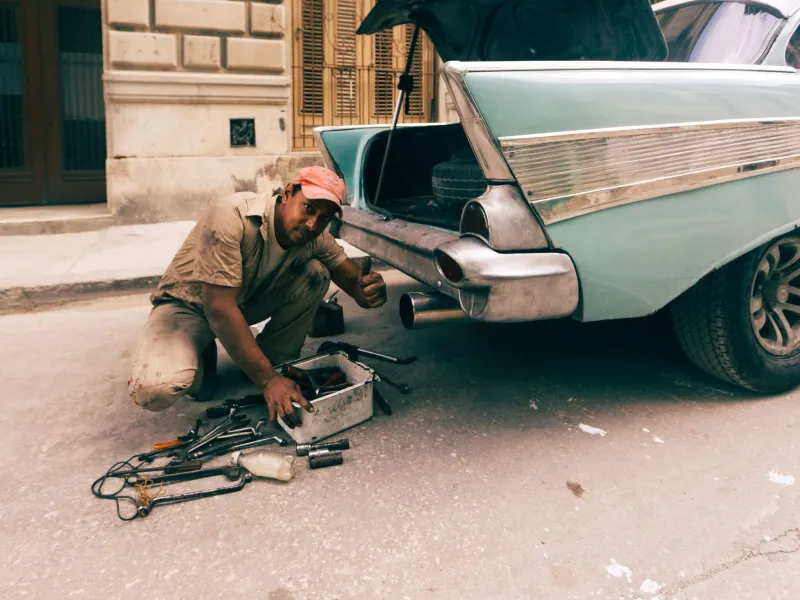
Pull into almost any suburban neighborhood on a Saturday morning in 1974 and you'd find the same scene: a pair of legs sticking out from under a Chevy, a transistor radio playing from somewhere near the garage, and a kid handing up tools like a surgical assistant who hadn't quite learned the names yet. The driveway was a classroom. The car was the curriculum.
That world is almost entirely gone now. And most people under forty have no idea it ever existed.
The Car You Could Actually Understand
Vehicles built through most of the 1960s and into the early 1980s were, by modern standards, almost charmingly simple. The engine was a mechanical system you could trace with your eyes. Fuel came in, air mixed with it, a spark fired, and the wheels turned. If something went wrong, the problem usually announced itself in a way that made physical sense — a smell, a sound, a visible leak, a worn part you could hold in your hand and compare to the new one at the parts counter.
Owner's manuals from that era weren't just warranty documents. They were genuinely instructional. Ford, Chevy, and Dodge published manuals that walked owners through tune-up procedures, brake adjustments, and basic electrical troubleshooting with the assumption that the person reading it had two hands and a few hours to spare. Haynes and Chilton repair guides sat on garage shelves next to cans of WD-40 and coffee cans full of mismatched bolts. These weren't professional tools. They were household items, like a cookbook for the car.
Changing your own spark plugs, swapping an air filter, adjusting the timing, replacing brake pads — these were weekend tasks that millions of ordinary Americans performed without a second thought. Not because they were mechanics by trade, but because the car made sense to them. It was a machine built at a scale a human being could comprehend.
When the Computer Took the Wheel
The shift started gradually in the late 1970s, accelerated through the 1980s, and by the mid-1990s it was essentially complete. Federal emissions regulations pushed automakers toward electronic fuel injection and computerized engine management systems. The carburetor — that adjustable, visible, cleanable heart of the old engine — disappeared. In its place came sensors, modules, and control units communicating in languages that required a diagnostic reader to interpret.
By the time the OBD-II port became standard on every vehicle sold in the US after 1996, the relationship between driver and machine had fundamentally changed. Your car now knew things about itself that you couldn't know without plugging in a computer. The check engine light — that amber symbol of modern automotive anxiety — became the primary way most people learned something was wrong. And the light didn't tell you what was wrong. It just told you to go find someone with the right equipment.
Today's vehicles are extraordinary pieces of engineering. The average modern car contains somewhere between 25 and 50 separate electronic control units. A high-end vehicle can have over 100. They manage everything from fuel delivery to suspension damping to the exact timing of your transmission shifts. The result is a car that performs better, lasts longer, and pollutes far less than anything built in 1972. Nobody serious is arguing otherwise.
But something was exchanged in the process.
What Got Lost in the Translation
The backyard mechanic didn't just save money — though he absolutely did. He also maintained a relationship with his vehicle that shaped how he thought about ownership, responsibility, and self-reliance. When you've replaced your own water pump, you understand viscerally what a water pump does. When you've bled your own brakes, you have a different relationship with the pedal under your foot. The car wasn't just transportation. It was something you understood, and that understanding meant something.
That knowledge passed between generations in a way that's become almost impossible to replicate. Fathers taught sons and daughters in driveways across the country, not through formal instruction but through proximity and repetition. You handed up the 9/16 socket. You watched the old gasket come off. You learned by being there.
Now, even mechanically curious owners run into walls almost immediately. Pop the hood on a modern vehicle and you're often looking at a plastic engine cover designed to hide the components beneath it. Reach for a component and discover it requires specialized tools, proprietary software, or calibration procedures that can only be completed by a dealer. Some manufacturers have fought hard against right-to-repair legislation that would allow independent shops — let alone individuals — to access the diagnostic data their own vehicles generate.
The local auto parts store still sells oil and filters and wiper blades. But the aisle of Chilton manuals has gotten noticeably thinner.
The Ritual, Not Just the Repair
Ask anyone who grew up in a household where cars got worked on, and they'll tell you it wasn't really about the car. It was about the Saturday. It was about the problem-solving. It was about the specific satisfaction of something broken becoming fixed through your own effort, with your own hands, in your own driveway.
That experience hasn't completely vanished. There are still weekend mechanics. There are still shade-tree restorers turning wrenches on old trucks and classic muscle cars, precisely because those vehicles still speak a language humans can understand. The vintage car hobby has never been more popular, partly because those old machines offer something modern vehicles can't — the feeling of genuine comprehension.
But for the daily driver sitting in your garage right now? The one with the touchscreen and the lane-keep assist and the adaptive cruise control? That car knows things about itself that you will never know. And when something goes wrong, you'll find out what it knows at an hourly labor rate you probably won't enjoy.
It's a trade-off most of us made without realizing we were making it. The cars got better. The connection got smaller. And somewhere in a garage that smells like motor oil and old coffee, a pair of legs sticking out from under a Buick became a memory instead of a Saturday.