The Workshop at the End of the Driveway Used to Be the Most Honest Room in the House
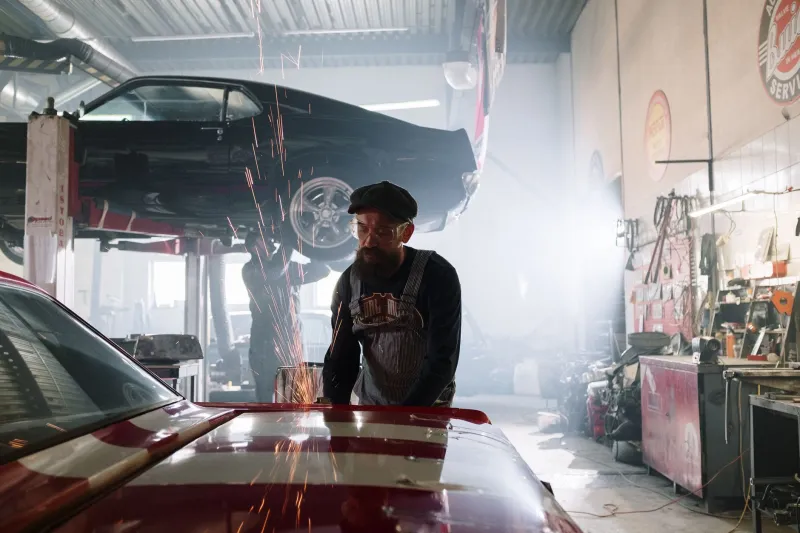
If you grew up in a certain kind of American household in the 1960s, 70s, or 80s, you probably spent at least some portion of your childhood hovering at the edge of a garage, watching an adult do something that looked like controlled chaos and turned out to be competence.
Maybe it was your father. Maybe a grandfather. Maybe the guy three doors down who always seemed to have something up on jack stands. There was a socket wrench involved, probably a radio tuned to AM, and a particular smell — motor oil and concrete dust and something metallic — that you'd recognize instantly today if someone bottled it.
That garage was a workspace. A real one. And it's largely gone.
What the Garage Used to Actually Be For
The American residential garage, in its original purpose, was built around the car — not to store it passively, but to interact with it. Oil changes happened there. Brake jobs happened there. Tune-ups, tire rotations, carburetor rebuilds, and the occasional transmission swap all happened in garages across suburban America, performed by people who were not professional mechanics but who had enough knowledge, enough tools, and enough stubbornness to figure it out.
But it wasn't only about the car. The garage was where projects lived. The birdhouse that never quite got finished. The outboard motor being refurbished for a fishing trip that kept getting postponed. The bicycle stripped down and repainted over a long winter. The garage held the evidence of a particular kind of American self-reliance — the belief that if something needed doing, you could probably do it yourself, given enough time and the right tools.
The pegboard wall with the tool outlines painted on it wasn't just organizational. It was a statement of identity. This is a person who knows how to use these things.
When Cars Outgrew the People Who Drove Them
The first thing that changed was the car itself.
Through the 1970s and into the 1980s, a mechanically inclined person with a decent set of tools and a repair manual could handle most of what their vehicle required. Engines were accessible. Systems were logical. You could see the parts, reach the parts, and understand what the parts were doing.
Then came the computer. Fuel injection. Electronic ignition. Drive-by-wire throttle systems. Sensors that communicated in diagnostic codes that required specialized readers to interpret. The modern automobile is, at its core, a software system wrapped in sheet metal, and the gap between what a home mechanic can realistically accomplish and what the car actually needs has grown into something close to a chasm.
You can still change your own oil. You can still swap wiper blades. But the days when a motivated amateur could meaningfully work on their own modern vehicle are largely finished, and the garage workshop culture that those vehicles sustained went with them.
The Storage Unit Wearing a Garage's Clothes
Walk into the average American garage today and you'll find the car — if it fits at all — sharing space with things that have nowhere else to go. Christmas decorations in labeled plastic bins. A treadmill that got moved out of the spare bedroom. A kayak that went out twice. Boxes from the last move that were never fully unpacked. A bicycle with a flat tire and optimistic intentions.
The tools, if they're there at all, are often a single set of basics purchased for a specific job and never expanded. The workbench, if there is one, is buried under things that needed to be put somewhere.
This isn't laziness. It's a reflection of real changes in how American life is structured. Working hours are longer. Leisure time is shorter and more fragmented. Homes are more expensive, which means the pressure to maintain them in resale condition is higher — and oil stains on a concrete floor don't help the appraisal. Streaming services have made the couch more competitive with the workshop. And perhaps most significantly, the car itself no longer invites engagement the way it once did.
What Tinkering Actually Taught
Here's the thing about working on something with your hands: you learn how things work. Not abstractly, not from a video — actually, physically, through the process of taking something apart and putting it back together.
The garage workshop was, for a generation of American kids, an informal classroom in mechanical reasoning. You learned that problems had causes. That causes could be identified. That with the right approach, most things could be fixed. You learned patience, because some bolts don't come loose easily. You learned that mistakes were recoverable, because your dad had made the same mistake and figured it out.
Those aren't just mechanical skills. They're cognitive habits. And they were transmitted in garages, over weekends, through the kind of side-by-side attention that doesn't require anyone to announce that a lesson is happening.
The Room We Stopped Using
The garage is still there, at the end of millions of American driveways. The concrete is still there. The overhead door still works. But the purpose has hollowed out, replaced by storage and sentiment.
Somewhere between the computerized engine bay and the packed schedule and the shrinking belief that fixing things yourself is worth the effort, the workshop quietly became a warehouse.
And the particular kind of confidence that came from working in that space — the knowledge that you could handle things, that you understood how the mechanical world operated, that you weren't entirely dependent on someone else every time something broke — that confidence got stored away too.
It's still in there, probably, somewhere behind the holiday bins and the unused treadmill. But it's getting harder to find.