The Nervous Kid, the Patient Teacher, and the School Sedan: What Happened to Driver's Ed
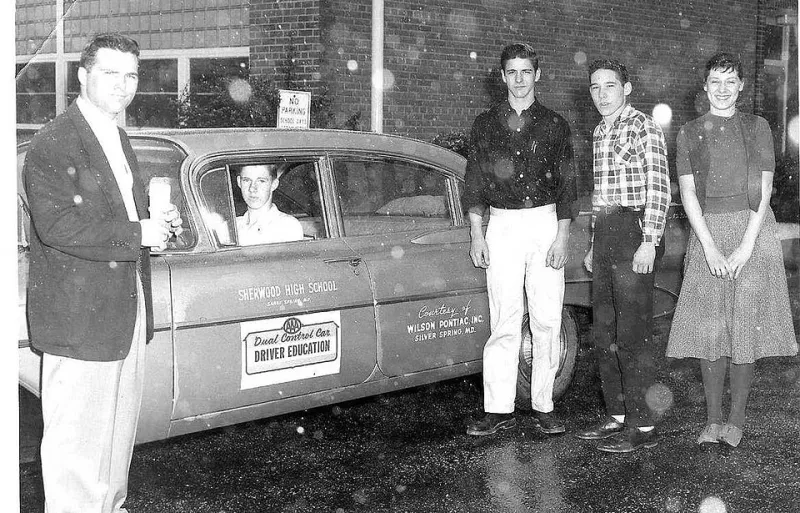
Photo: School yearbook team., Public domain, via Wikimedia Commons
The Class That Felt Like Adulthood
For a certain generation of American teenagers, driver's education was the class that actually mattered. Not because it was graded — though it was — but because it was the first time a school looked at you and said: we're going to teach you something that could save your life.
The setup was almost universal across the country. A dedicated classroom unit on traffic laws, road signs, and defensive driving. A behind-the-wheel component in a school-owned vehicle — usually a forgettable American sedan with a brake pedal on the passenger side and a patient teacher who had seen it all. Sometimes a driving simulator that looked like it belonged in a 1970s science fair. And at the end of it, a teenager who had been taught, by professionals, how to operate a two-ton machine on public roads.
It wasn't glamorous. It wasn't always exciting. But it was thorough, it was free, and it was available to every kid in the building regardless of what their parents could afford or how much time those parents had to spend in a parking lot.
Most American high schools don't offer it anymore. The shift happened slowly, then all at once, and the country is still absorbing the consequences.
How It Used to Work
At its peak — roughly the 1960s through the 1980s — in-school driver's education was a fixture of American public education. The American Automobile Association had been advocating for standardized driver's ed since the 1930s, and by the postwar era, most states had incorporated it into high school curricula either as a required course or a heavily subsidized elective.
 Photo: American Automobile Association, via c8.alamy.com
The classroom portion covered the rules of the road, but also the physics of driving — stopping distances, the effect of speed on reaction time, what happens to a car in rain or ice. Students learned that driving wasn't just about steering; it was about anticipating, reading the road, and understanding that the machine they were operating had real consequences when mishandled.
The behind-the-wheel portion was where the nerves showed up. A student and a teacher, and sometimes one other student in the back seat, would spend hours navigating school zones, highway on-ramps, parallel parking on quiet streets, and three-point turns in empty lots. The dual-control car meant the teacher could intervene if things went sideways — and they sometimes did.
This wasn't just instruction. It was mentorship. Many drivers still remember their driver's ed teacher by name decades later, which is more than they can say for most of their other high school instructors.
The Budget Ax Falls
The dismantling of public school driver's education didn't come from a single decision — it came from a thousand small ones, made by school boards across the country over roughly three decades.
The economics were genuinely difficult. Maintaining a fleet of training vehicles is expensive. Insurance for student drivers is expensive. Paying a certified instructor is expensive. As state education budgets tightened in the 1980s and accelerated through the 1990s, driver's ed became an easy target. It wasn't tested on standardized exams. It didn't directly affect school rankings. And private driving schools existed that could theoretically fill the gap.
So the programs got cut. First the cars. Then the classroom hours. Then the course itself, replaced by a referral to a local driving school and a state licensing process that required teens to log a certain number of supervised hours — hours that would now fall entirely on parents and private instruction.
By the 2000s, the AAA estimated that only about a third of American high schools still offered meaningful driver's education programs. In many states, the number was lower.
What the Private Market Gave Us Instead
The private driving school industry stepped into the void, and to be fair, some of those schools are excellent. Experienced instructors, modern vehicles, flexible scheduling — for families who can access and afford them, private driver's ed can work well.
But that phrase — families who can access and afford them — is doing a lot of work.
Private driver's education in the United States costs anywhere from $200 to $800 or more depending on the state and the number of hours required. For working-class families, that's a real barrier. And even for families who can afford it, the experience is fragmented in ways that public school programs weren't. There's no shared curriculum, no consistent standard, and no built-in social context — no classmates going through the same experience at the same time.
The other alternative — parents teaching their kids in parking lots and quiet neighborhoods — is free, but wildly inconsistent. A parent who is an excellent driver is not necessarily an excellent teacher of driving. And a teenager whose parent is anxious, distracted, or simply too busy is getting a very different education than the one they would have received from a trained professional.
The Skill That Schools Stopped Believing In
There's a cultural dimension to this that goes beyond the practical. When schools offered driver's education, they were making a statement: this is a life skill worth teaching properly, and it's our job to make sure every student has access to it.
When they stopped, they made a different statement, even if nobody said it out loud: this is a personal responsibility, a market transaction, a family problem — not ours.
That shift reflects something broader about how American education has narrowed its definition of what schools are for. The vocational, the practical, the life-skill — shop class, home economics, driver's ed — all gradually retreated in favor of academic preparation and standardized testing. Schools became more focused and, in some ways, less useful for the actual business of living.
A teenager who graduated from an American high school in 1975 probably knew how to drive, how to change a tire, how to balance a checkbook, and how to cook a basic meal. Schools taught those things because someone decided they mattered.
Somewhere along the way, that someone changed their mind.
What the Nervous Kid in the Passenger Seat Knew
The driver's ed teacher sitting in that passenger seat — brake pedal within reach, clipboard on the knee, voice steady while a 16-year-old misjudged a left turn — was doing something that sounds simple and wasn't: teaching a scared kid that they were capable of handling something real.
That experience, repeated millions of times in school parking lots across America for half a century, produced generations of drivers who knew not just how to operate a car, but why the rules existed and what was at stake when they failed.
We outsourced that. To the market, to the parents, to whoever happened to be available. And we called it a budget decision, because that's what it looked like from close up.
From far enough back, it looks like something else: the quiet decision that some things aren't worth teaching anymore — right up until you realize they were.