The Envelope That Made You Wait: How Developing Film Taught Us to Remember Differently
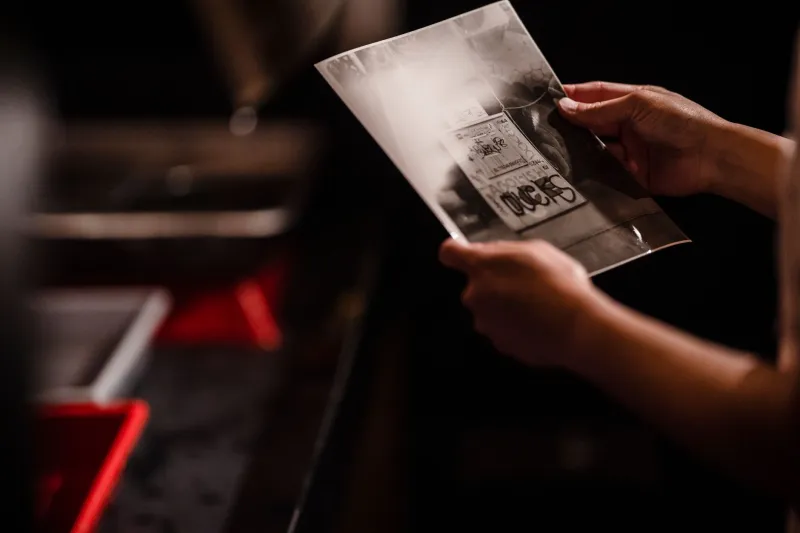
The envelope was usually yellow or white, sometimes red. It came back from the drugstore or the one-hour photo lab with your name written on the outside in ballpoint pen, and you tore it open the way you'd open a letter from someone you'd been missing. Inside: a stack of four-by-six prints, slightly glossy, smelling faintly of chemicals, and carrying a record of something that had happened weeks ago.
Some photos were perfect. Some were blurry, or badly lit, or featured someone mid-blink with their eyes half-closed. A few were complete mysteries — you'd forgotten entirely what you'd been trying to photograph. And a handful were genuinely beautiful, the kind you'd slip into a frame or pass around the table for everyone to hold.
For most of the twentieth century, this was simply what photography was: a deferred experience, a conversation between a moment and its memory, separated by time.
Twenty-Four Frames and a Reason to Choose
The standard roll of 35mm film gave you twenty-four exposures. Some rolls ran to thirty-six. Either way, you had a fixed number of shots, and each one cost something — not just in film, but in development fees that added up fast if you were careless.
That constraint shaped behavior in ways that are almost invisible now. You didn't photograph everything. You couldn't. You made decisions, consciously or not, about what was worth capturing. The birthday cake, yes. The drive to the party, maybe not. The moment your kid finally rode a bike without training wheels, absolutely — but you'd better be ready, because you only had a couple of frames left on the roll.
This wasn't a burden. It was a discipline that gave photographs a kind of weight. Each image had been chosen. Someone had decided, in the moment, that this was worth one of their twenty-four chances. That decision is baked into every old photograph in a way that most digital images simply aren't.
Families would sometimes stretch a single roll across months — summer vacation, back to school, Halloween, Thanksgiving — creating an accidental archive of a whole season in a single packet of prints. You'd get the photos developed in December and suddenly be looking at July again. The disorientation was its own kind of pleasure.
The Wait Was Part of the Story
The delay between taking a photo and seeing it wasn't just a technical limitation. It became part of how photographs functioned in family life.
You talked about photos before you had them. "I hope that one turned out." "I got a great shot of Grandma, I think." The uncertainty created a kind of narrative anticipation. When the prints finally arrived, the act of looking at them was a genuine event. You sat down with them. You passed them around. You told the story of each image to anyone who hadn't been there, and retold it even to people who had.
The photo album emerged from this ritual. Prints were physical objects — they needed a home. Families organized them into albums with sticky pages and plastic overlays, creating a curated record of their history. The act of assembling an album was itself a form of storytelling: choosing which photos made it in, arranging them in sequence, sometimes adding captions in handwriting that would outlast the people who wrote it.
These albums became heirlooms. They were the thing you grabbed from the house if there was a fire. They were the first thing people looked through at a family gathering. They were irreplaceable in a way that felt obvious, because there was no backup copy, no cloud storage, no second chance.
When the Wait Ended
Digital cameras became consumer products in the late 1990s, and by the mid-2000s, they had essentially replaced film for everyday use. The iPhone arrived in 2007 and put a camera in every pocket. Within a decade, more photographs were being taken every two minutes than had been taken in the entire nineteenth century.
The constraint evaporated. Storage was cheap, then free. You could take a hundred photos of your kid's soccer game and sort them out later — or never sort them at all. The cost of a bad photograph dropped to zero, and with it went the reason to be selective.
Instant feedback changed the act of taking pictures entirely. You could check the screen immediately, delete what didn't work, and try again. The uncertainty was gone. So was the discipline. And so, gradually, was the ritual of the reveal.
Today, most people have thousands of photographs on their phones that they've never looked at twice. The images are technically superior to anything a drugstore one-hour lab ever produced — sharper, better exposed, perfectly color-balanced. And yet the average digital photo receives less sustained attention than the blurriest print from a 1987 roll of Kodak Gold.
What We Actually Remember
There's a paradox buried in this story. We are photographing more than at any point in human history. We are capturing more moments, more faces, more ordinary Tuesdays than any previous generation thought worth recording. And yet many people report feeling like their memories are somehow less vivid, less anchored, less theirs.
Memory researchers have a name for this: the photo-taking impairment effect. When you photograph something, your brain partially outsources the task of remembering it. You were there, but you were also behind the lens, and the act of capturing the image can actually reduce how well you encode the experience itself.
The old way — taking fewer photographs, waiting for them, handling the prints, placing them in albums — forced a kind of repeated engagement with memory. You remembered the moment when you took the shot. You remembered it again when the prints came back. You remembered it a third time when you put it in the album. Each pass deepened the groove.
Now the photo goes into a camera roll with ten thousand others, and the groove never gets cut.
The Yellow Envelope as a Time Machine
If you've ever found an old box of prints in a closet — really found them, unexpectedly, the way you find things you'd forgotten you'd kept — you know the feeling. It's different from scrolling through a phone. The photos are physical. They have weight. Some of them are faded or bent at the corners. Someone held these. Someone chose these.
The wait that produced them wasn't a flaw in the system. It was the system. It built anticipation, enforced selectivity, and created a ritual around memory that made the past feel worth preserving.
We traded all of that for the ability to see our photos the instant we take them. It's a fair trade in some ways. But the next time you scroll past a thousand images looking for one you actually remember taking, it's worth wondering what the wait was really worth.