The Screen Went to Static at Midnight and That Was That: What TV Looked Like When It Had an Ending
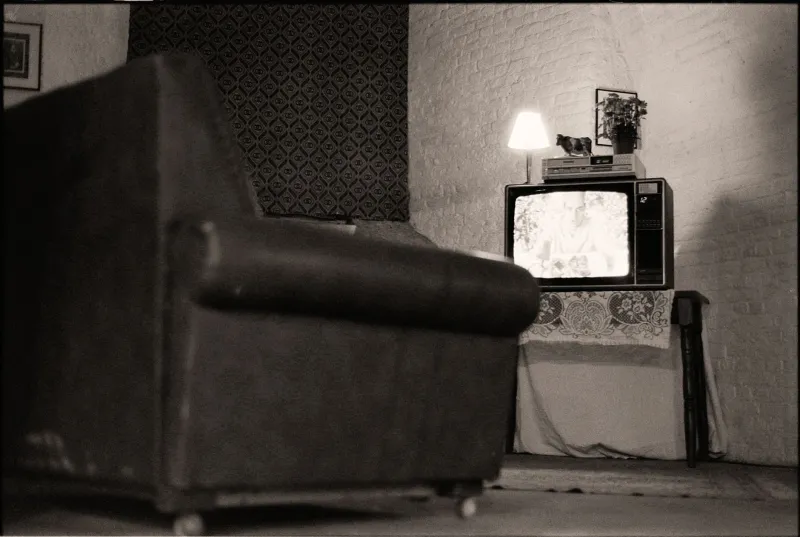
Somewhere around 11:30 on a weeknight in 1974, a local news anchor signed off with a familiar phrase, the station ran a public service announcement or two, and then — if you were still watching — the national anthem played over footage of a flag waving in slow motion. And then nothing. A test pattern. Static. The television had finished for the day, and so had you.
There was no next episode queued up. No algorithm suggesting something you might also enjoy. No autoplay counting down from five. The television simply stopped, and the only sensible response was to go to bed.
It's hard to fully describe that experience to someone who grew up with a remote in one hand and a streaming password in the other. The idea that a screen could just end — that the content could run out — feels almost conceptually foreign now. But for the first four decades of American television, that's exactly how it worked.
You Watched When They Said You Could
Broadcast television in its classic era operated on a logic that was completely inverse to how we consume media today. Instead of content waiting for you, you waited for the content.
The networks — ABC, NBC, CBS, and eventually a handful of local independents — decided what aired and when. If you wanted to watch M*A*S*H, you watched it on Monday nights at 9 PM Eastern. If you missed it, you missed it. There were no reruns guaranteed, no catch-up services, no way to pause and come back later. The show ran when it ran, and the country watched together or not at all.
This scheduling tyranny sounds maddening by modern standards, but it produced something genuinely remarkable: a synchronized national audience. On the night of the M*A*S*H series finale in February 1983, over 106 million Americans watched the same episode at the same time. It remains one of the most-watched television broadcasts in US history. The next morning, everyone — everyone — was talking about the same thing. Not because an algorithm had served it to them, but because they had all shown up at the same moment and experienced it together.
The Ritual of Appointment Viewing
Because television had a schedule, watching it required a kind of commitment that streaming has completely dissolved. You planned around your shows. You made sure you were home. If something important was on and you had to miss it, you called a friend and asked them to describe it.
This gave individual episodes a weight they rarely carry today. When something significant happened on a show — a character died, a couple finally got together, a plot twist landed — it happened to the entire audience simultaneously. The conversation that followed was immediate, nationwide, and shared. There was no "no spoilers, I haven't gotten there yet." Everyone was always at the same place because the medium only moved in one direction, at one speed, for everyone.
Family viewing was different, too. With only three or four channels to choose from, the act of picking something to watch was a genuine negotiation. Dad wanted the news. The kids wanted cartoons. Mom had a show she'd been following all season. Someone compromised. Someone grumbled. And then you all sat down together and watched the same thing, in the same room, for the same hour.
That shared physical experience — the whole family on the couch, arguing about the channel, eating dinner with the TV on — has been fragmented almost completely. Everyone has their own screen now. Their own queue. Their own algorithm. The living room television, once the undisputed center of household entertainment, is now just one of several options competing for attention.
Three Channels Was Actually Enough to Argue About
The scarcity of options sounds like a deprivation until you sit with it for a minute. With only a few channels available, the shows that broke through had to be genuinely good — or at least genuinely broad. They had to appeal to enough people to survive in a competitive slot. Niche programming couldn't really exist because there wasn't enough space for it, which meant the shows that did exist had to find common ground across a wide audience.
That's part of why television from the broadcast era punched so hard culturally. All in the Family, The Cosby Show, Cheers, Seinfeld — these weren't shows for a specific demographic slice. They were shows for America, in the broadest possible sense, because that's what the medium required.
Today, the math runs completely differently. Netflix alone has thousands of titles. HBO Max, Peacock, Disney+, Apple TV+, and a dozen other platforms add thousands more. The choice is genuinely staggering — and research consistently shows that more options don't make people happier. They make people anxious. The phenomenon even has a name: the paradox of choice. When everything is available all the time, the decision of what to watch becomes its own source of stress, and the experience of watching feels less special because it cost you nothing to access it.
What the Static Actually Meant
When the broadcast day ended and the static came on, it did something psychologically useful: it told you the evening was over. There was a natural stopping point built into the medium itself. You couldn't watch one more episode because there were no more episodes. The television made the decision for you, and you went to bed.
Nobody misses the static, exactly. But a lot of people probably miss what it represented — a built-in limit on consumption, a shared national schedule, and the particular electricity of a cultural moment that everyone experienced at the same time.
Streaming gave us freedom. Broadcast gave us company.
Before you blinked, the screen went dark at midnight, and somehow that was enough.