When Your Bike Was Your Car and Summer Lasted Forever: How We Locked Up Childhood's Greatest Freedom Machine
The Democracy of Two Wheels
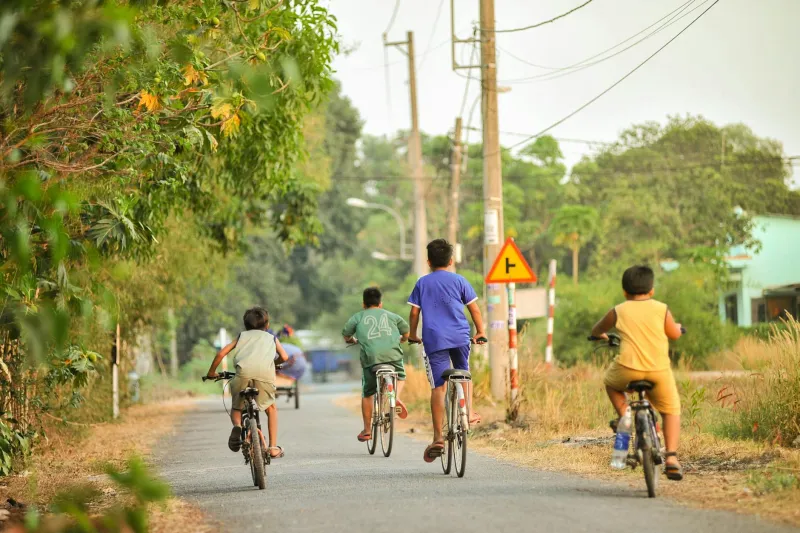
Every kid on Maple Street had a bike, and every bike told a story. Tommy's was a hand-me-down Schwinn with rust spots and a playing card clothespinned to the spokes for that perfect motorcycle sound. Sarah's was a shiny new Huffy with a banana seat and streamers flowing from the handlebars. Mike's was cobbled together from parts his dad found at garage sales—mismatched wheels, a bent frame, but it rode like the wind.
 Photo: Maple Street, via images.squarespace-cdn.com
None of them wore helmets. All of them disappeared for hours.
This was 1975, when a bicycle wasn't exercise equipment or a statement about environmental consciousness. It was pure, distilled freedom in mechanical form—your first taste of independence, your ticket to everywhere, your escape from the gravitational pull of home.
The Geography of Adventure
A kid's world in the 1970s was measured in bicycle distance. The corner store was five minutes away. The creek where you caught tadpoles was fifteen minutes if you pedaled hard. The really good sledding hill was a twenty-minute journey that felt like crossing state lines.
Parents didn't track these expeditions. There was no Find My Friends app, no scheduled play dates, no adult supervision beyond "be home when the streetlights come on." Your bike was your passport to a parallel universe where kids made the rules and adults existed only at the margins.
You'd wake up on a Saturday morning, grab your bike from wherever you'd dropped it the night before, and just... go. Maybe you'd end up at the abandoned lot where someone had built a dirt ramp. Maybe you'd ride to the 7-Eleven for Slurpees. Maybe you'd just cruise the neighborhood, looking for other kids to join your impromptu adventure.
The destination mattered less than the journey, and the journey was always better with friends.
The Unspoken Rules of Bike Culture
Every neighborhood had its bicycle ecosystem, with unwritten laws that governed everything from territorial boundaries to sharing protocols. You could borrow someone's bike if yours was broken, but you'd better return it with the same amount of air in the tires. Racing was always acceptable, but showing off was tolerated only if you could back it up with actual skill.
The really cool kids could ride no-handed, pop wheelies on command, and take corners at speeds that would terrify today's helicopter parents. These weren't stunts performed for YouTube views—they were essential skills in the social hierarchy of childhood, demonstrations of competence that earned respect and admiration.
Bikes were left unlocked everywhere. Front yards, school bike racks, outside the movie theater—security was based on the assumption that stealing someone's bike was simply unthinkable. The worst thing that might happen was someone would "borrow" it for a quick ride around the block.
When Exercise Was Called Playing
Today's parents buy their kids bicycles for exercise, carefully researching proper helmet fits and planning family bike rides along designated trails. Cycling has become a supervised activity, complete with safety gear, route planning, and adult oversight.
But kids in the 1970s didn't ride bikes for fitness—they rode for fun, and the fitness happened accidentally. You'd pedal for miles without realizing you were exercising, chase friends through neighborhoods without considering the cardiovascular benefits, race to beat the sunset without thinking about your heart rate.
The bike was a tool for adventure, not a piece of exercise equipment. It was transportation to wherever your imagination wanted to go, not a way to burn calories or build leg strength.
The Professionalization of Childhood Recreation
Something fundamental shifted in American childhood over the past forty years. Activities that used to be informal and kid-directed became organized and adult-supervised. The bicycle, once the ultimate symbol of unstructured play, got absorbed into the machinery of scheduled recreation.
Today's kids might own better bikes—lighter frames, more gears, superior engineering—but they ride them less freely. Bike rides happen on weekends, along predetermined routes, with parents nearby. The spontaneous expedition to nowhere in particular has been replaced by the planned family outing with specific destinations and safety protocols.
Even kids who do ride independently navigate a world where unattended children on bicycles trigger concerned phone calls to police. The same freedom that defined childhood in the 1970s now reads as neglect or danger.
The Adult Appropriation of Bike Culture
As children's relationship with bicycles became more restricted, adults discovered cycling with the enthusiasm of converts. Bike shops that once catered primarily to kids now focus on serious adult cyclists with serious adult budgets. A decent adult bike costs more than a used car.
Cycling became fitness, recreation, environmental statement, and lifestyle choice. Adults joined cycling clubs, planned bike vacations, and spent weekends on organized rides with names like "Tour de Whatever" and "Century Challenge." The bicycle transformed from a child's toy into an adult's hobby.
This isn't necessarily bad—adult cycling culture has created better infrastructure, safer roads, and more respect for bicycles as legitimate transportation. But something was lost when bikes stopped being primarily about childhood freedom and started being about adult fitness goals.
The Helmet Debate That Missed the Point
The introduction of mandatory helmet laws sparked passionate debates about safety versus freedom, protection versus risk-taking. Parents who grew up riding helmetless struggled with requiring their own children to wear protective gear that would have been unthinkable in their youth.
But the helmet debate obscured a larger transformation: the shift from bikes as tools of independence to bikes as objects requiring supervision. Whether kids wore helmets mattered less than whether they were allowed to ride freely, to explore without destinations, to experience the pure joy of movement through space under their own power.
Safety equipment became a symbol of broader changes in how Americans thought about childhood, risk, and the balance between protection and freedom.
What We Lost When We Got Careful
Today's children are safer, more supervised, and more protected than any generation in history. They're also more scheduled, more anxious, and less independent. The bicycle—once the great democratizer of childhood adventure—became another activity requiring adult involvement and safety protocols.
We gained protection and lost exploration. We reduced risk and eliminated the kind of unstructured discovery that happens when kids are allowed to just... ride. The bicycle is still a beautiful machine, still capable of providing transportation and joy and freedom.
But it's no longer the key to a parallel universe where children make their own rules and create their own adventures.
The Eternal Summer That Ended
Somewhere in suburban America, there might still be neighborhoods where kids drop their bikes in front yards, disappear for hours, and return home with scraped knees and stories of epic adventures. Where summer afternoons stretch endlessly and the only schedule is the rhythm of pedaling toward whatever looks interesting.
Those neighborhoods are rarer now, protected by parents who remember their own bike-riding childhoods but can't quite bring themselves to recreate them for their own children. The world feels more dangerous, even though it's statistically safer. The freedom feels more precious because it's so much scarcer.
The bicycle is still there, waiting in garages and bike shops, ready to provide the same joy and freedom it always has. The question is whether we'll let it, or whether we've forgotten how to trust our children with the simple, profound adventure of going wherever the road leads.
Summer is still summer. The road still calls. The only thing that changed is our willingness to answer.