Frozen in October: What We Lost When the Yearbook Stopped Being the Final Word on Who You Were
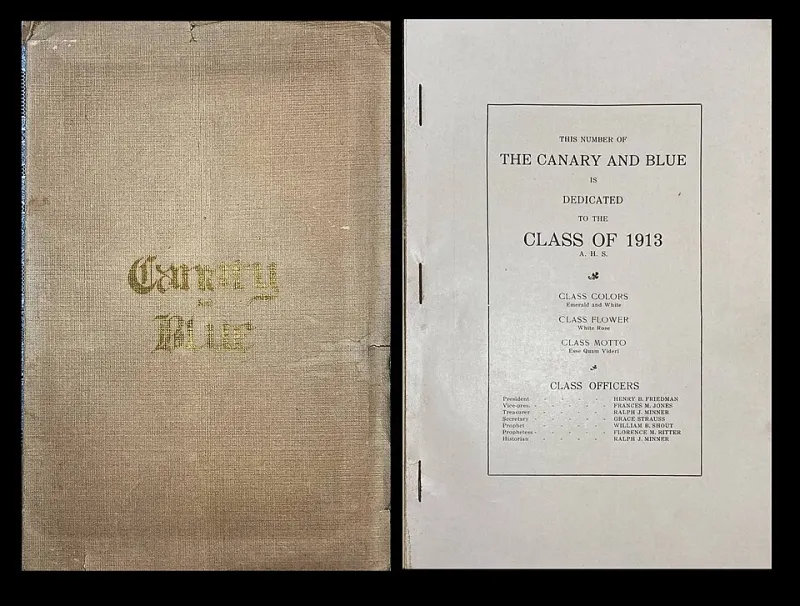
Photo: self scanned, Public domain, via Wikimedia Commons
Somewhere in your parents' closet — or your own, if you're old enough — there's a book with a laminated cover and the faint smell of old paper. Inside it, a version of you exists that you cannot touch. Hair you'd never wear again. A shirt you forgot you owned. An expression caught between trying to look cool and trying not to blink under the photographer's lights.
That version of you is permanent. It was always permanent. That was the whole deal.
The Annual That Meant Everything
The high school yearbook has been an American institution since the late 1800s, but it hit its cultural peak somewhere in the postwar decades — the 1950s through the 1980s — when it served a function that's genuinely hard to explain to anyone who grew up with a smartphone.
It was the only record.
Not the only convenient record, or the only affordable one. The only one. If you wanted to know what your classmates looked like, who played on the football team, which teacher had been there since before your parents graduated, the yearbook was it. There was no other archive. No tagged photos, no digital albums, no social media profiles stretching back to middle school. Just 200 glossy pages produced once a year by a group of students in a room that smelled like rubber cement and ambition.
The photograph that appeared next to your name was taken in a single session, usually in September or October, and that was your entry in the permanent record. You didn't get to choose from forty-seven shots. You didn't get a filter. You didn't get to retake it because the light was unflattering. You got what you got, and what you got was printed and distributed to everyone you knew.
The Weight of Being Documented
There's something worth sitting with here, because it cuts against everything we've been trained to think about documentation and memory.
Being unretouchably recorded — frozen in a single, unchosen moment — sounds like a limitation. And in some ways it was. Bad hair days became permanent. The kid with the unfortunate yearbook photo carried it for years, through reunions and Facebook rediscoveries and the inevitable moment someone dug out the old book at Thanksgiving.
But that permanence also carried a kind of dignity.
The yearbook didn't require you to perform. It didn't reward the most curated version of yourself. It captured you as you actually were on a Tuesday in October when you sat down in front of a photographer who had forty kids to get through before lunch. The result was, in the truest sense of the word, authentic — not because it was beautiful, but because it was unmanaged.
And the captions that accompanied club photos, sports rosters, and candid shots were written by other teenagers who had maybe two column inches to work with and no ability to A/B test their phrasing. What they wrote stayed written. The future self who might have preferred a different description had no recourse.
The Social Architecture of the Signature Page
The ritual of getting your yearbook signed deserves its own examination, because it was a social system as intricate as anything that exists on the internet today — and it operated entirely in person, in real time, with permanent ink.
You handed your yearbook to someone and waited while they decided what to write. That decision — what do I say to this person, in this space, that will exist forever? — carried genuine weight. The inscription from your best friend was different from the one from your crush, which was different from the one from the teacher who actually believed in you. Reading them later, you could reconstruct the entire social landscape of your teenage years from the tone and length of a hundred handwritten notes.
Stay cool. Don't ever change. KIT — Keep In Touch. Those phrases sound like clichés now. But they were sincere attempts, made under real time pressure, to say something true about a relationship. Nobody was performing for an audience. The yearbook was passed directly from hand to hand.
Identity That Couldn't Be Edited
Here is where the contrast with today gets genuinely interesting.
The modern teenager exists in a state of constant identity management. Social media profiles are curated, updated, and — crucially — revisable. A post from three years ago can be deleted. A photo can be archived. A bio can be rewritten to reflect whoever you've decided to become this semester. The digital record of your adolescence is, in theory, entirely under your control.
This sounds like freedom. And in some ways it is. The ability to grow past an embarrassing moment without it following you forever is genuinely valuable. Nobody should be defined permanently by who they were at sixteen.
But the flip side is something we don't talk about as often: when everything is editable, nothing is quite real. The curated profile is a construction. It represents the self you want to project, not the self that got caught in the photographer's flash on a Tuesday morning. And because everyone knows the profile is curated, it carries less weight as evidence of who you actually are.
The yearbook photo, precisely because it was unmanaged, was trusted. It was proof. This is what you looked like. This is where you sat. This is the team you were on, the club you joined, the face you showed the world when you weren't thinking about how you looked.
What the Algorithm Can't Archive
Digital memory is vast and searchable and theoretically permanent — but it's also fragile in ways the yearbook never was. Platforms disappear. Accounts get deleted. Formats become obsolete. The photos on your phone right now are stored on servers owned by companies that may not exist in twenty years.
The yearbook sitting on your parents' shelf has already outlasted three social media platforms. It requires no password, no subscription, no compatible software. You open it and there you are.
There's something the analog record understood that the digital one is still figuring out: permanence isn't about volume. It's about commitment. The yearbook committed to a single version of you, printed it in ink, and handed it to everyone you knew. That commitment meant something.
Before the blink, you couldn't edit the past. You could only live forward from it. Maybe that was harder. Maybe it was also, in some way we're only beginning to understand, better.