Everything You Needed Was in the Glove Box: The Car That Used to Be a Self-Contained World
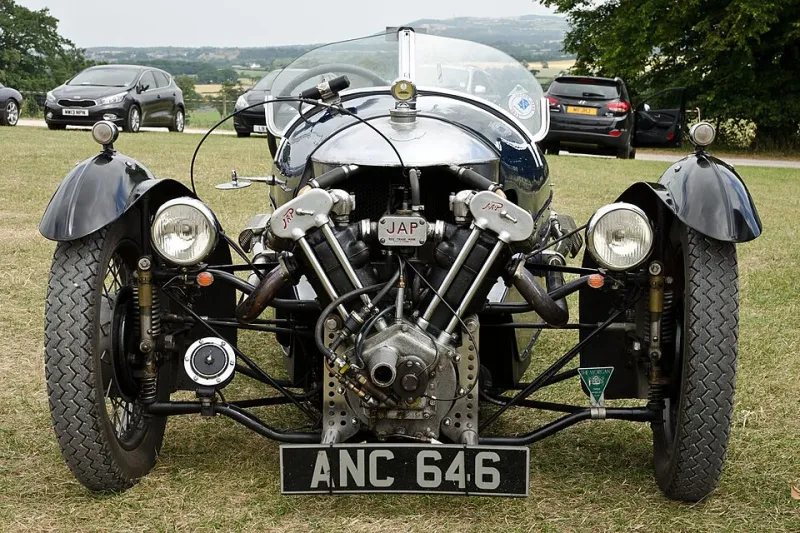
Photo: SG2012, CC BY 2.0, via Wikimedia Commons
Everything in Its Place
Open the glove compartment of almost any American car from the 1970s, '80s, or '90s and you'd find a specific kind of organized chaos that somehow made perfect sense. The vehicle registration, folded into a small plastic sleeve. The owner's manual, dog-eared at the section someone had actually needed once. A flashlight — probably a heavy metal one with batteries that may or may not still work. A pen. Maybe a small notepad. Emergency cash, usually a folded twenty tucked behind the manual.
And in the back seat, or wedged between the seats, or stuffed into a door pocket: the maps. State maps, city maps, the dog-eared road atlas that had been in the family since 1988 and had coffee stains on the page for Missouri.
This was the American car as a self-contained unit. You didn't need anything outside of it to navigate, handle an emergency, or prove you owned the thing. Everything necessary was physically present, within arm's reach, and required no battery, no signal, and no password.
That world is almost completely gone. And it disappeared so gradually that most of us didn't notice we'd stopped being prepared.
The Art of Knowing Where Things Were
There's something worth pausing on here: people actually knew where their stuff was.
It sounds like a small thing. It isn't. The act of physically organizing a car — deciding where the registration lived, making sure the flashlight worked before a long trip, folding a map back into something approximating its original shape — was a form of low-level competence that we practiced constantly without thinking of it as a skill.
You also knew the car's geography in a way that felt almost personal. The cupholder that only worked with certain cup sizes. The seat pocket that could hold exactly two maps if you folded them right. The little tray above the visor where you kept the toll quarters. Cars had physical personalities, and drivers learned them.
This wasn't just convenient — it was grounding. You were in charge of your own preparedness. If you ran out of gas on a back road in rural Pennsylvania, you had a map to figure out where the nearest town was. If it was dark, you had a flashlight. If you needed to leave a note on someone's windshield, you had a pen.
You were, in the most practical sense, capable.
The Slow Handover to the Cloud
The transition away from all of this didn't happen overnight, but it accelerated sharply around 2010 when smartphones became genuinely useful navigation tools and insurance companies started offering digital ID cards.
First went the maps. GPS had been creeping in since the early 2000s — those early Garmin units suckered to the windshield — but once Google Maps became a phone staple, the road atlas moved from the back seat to the garage to the recycling bin. Nobody mourned it much. Navigation got dramatically better. That part was objectively true.
 Photo: Google Maps, via beconnected.esafety.gov.au
Then the insurance card went digital. Then the registration, in some states, became acceptable as a phone screenshot. The owner's manual migrated to a QR code or a website. The emergency cash quietly disappeared as tap-to-pay became universal and ATMs seemed to be everywhere.
Each individual substitution was sensible. Digital insurance cards can't be lost or forgotten. GPS is vastly more accurate than a 1991 Rand McNally. Nobody's arguing otherwise.
But the cumulative effect was significant: the car stopped being self-sufficient, and so did the driver.
What Happens When the Battery Dies
Here's the quiet problem that nobody talks about until they're standing on the side of a highway with a dead phone.
If your smartphone dies today — truly dies, not just needs a charge — you lose navigation, your proof of insurance, potentially your roadside assistance membership, the phone number for anyone you'd want to call, and the ability to look up where the nearest gas station is. You might not even know your own spouse's phone number by heart, because it's been stored in your contacts for 15 years and you've never had to dial it manually.
The car itself is no help. Modern vehicles have beautiful 12-inch touchscreens that, when disconnected from your phone, become expensive digital clocks. The glove compartment, if it has anything in it at all, probably holds a takeout menu and a phone charger cable.
This is what digital dependency looks like in practice: not a dramatic failure, but a quiet erosion of the skills and tools that used to make us capable of handling small emergencies on our own.
The Cassette Tapes Are Gone Too
It would be incomplete to talk about what cars used to carry without mentioning the music.
The center console or the back-seat floor of a family car in the 1980s almost certainly held a collection of cassette tapes — or later, a binder of CDs — that told you more about that family than almost anything else in the vehicle. The mix tapes. The road trip albums. The kids' sing-along cassette that got played so many times the ribbon started to stretch.
Music, like maps and emergency supplies, was a physical thing you owned and carried. It was curated by hand. It was yours in a way that a Spotify playlist, however carefully assembled, simply isn't.
When that went away, something small but real went with it.
Prepared vs. Connected
The modern connected car is a marvel. Real-time traffic, over-the-air software updates, automatic collision detection, remote start from your phone. Nobody who has experienced these things wants to go back to a paper map and a flashlight with dead batteries.
But there's a version of preparedness that the old system enforced by its very limitations. When you had to carry everything yourself, you thought about what you might need. You planned. You maintained. You were, in the truest sense, ready.
Now we're connected to everything and dependent on that connection in ways we don't fully appreciate until it breaks. The glove compartment is empty. The back seat is clean. The road atlas is gone.
And somewhere on a back road with no signal, a driver is realizing — too late — exactly what that cost.