The Suitcase That Outlived Its Owner: When Luggage Was Something You Kept Forever
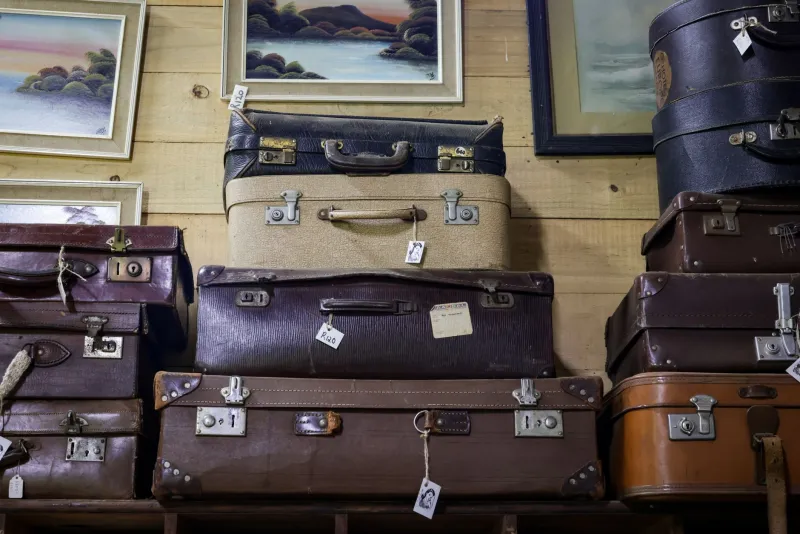
There's a good chance someone in your family has one. A battered leather suitcase sitting in a closet or an attic, its brass clasps still clicking shut with a satisfying snap, its stitching intact after fifty or sixty years of hard use. Maybe it has a luggage tag from a hotel that no longer exists. Maybe there's a faded sticker from a steamship company on the side. Whatever its history, it's probably still perfectly functional — which is more than you can say for the spinner bag you bought at the airport gift shop three years ago.
We used to buy luggage the way we bought furniture. Carefully, infrequently, and with the quiet assumption that it would be around long after we were done with it.
The Art of the Serious Suitcase
For most of the twentieth century, buying luggage was a considered decision. Department stores like Marshall Field's and Macy's had dedicated luggage departments staffed by people who actually knew what they were selling. A good set of bags — typically a large trunk, a mid-size case, and a smaller overnight bag — represented a real investment. Hartmann, Samsonite's higher-end lines, and imported European leather houses made pieces that were built to take punishment across ocean liners, rail platforms, and cobblestone streets.
The materials reflected the intention. Full-grain leather, vulcanized fiber, solid brass hardware. The stitching was reinforced at every stress point. The hinges were designed to be repaired, not replaced. Monogramming wasn't just decorative — it was a statement that this object was yours in a permanent, personal way.
When a family member passed away, their luggage was often passed down alongside their furniture and silverware. It was considered a useful inheritance, not a sentimental curiosity. Because it still worked. Because it was meant to.
The Democratization That Changed Everything
The shift started in the 1970s and accelerated sharply through the 1980s and '90s. Air travel became accessible to the middle class in a way it never had been before, and the luggage industry responded by scaling for volume rather than longevity. New synthetic materials — nylon, polyester, ABS plastic — made it possible to produce bags cheaply and in enormous quantities. Prices dropped. Choices multiplied.
The rolling suitcase, introduced widely in the late 1980s, genuinely changed everything about how people traveled. Suddenly you weren't hauling a dead weight through an airport — you were gliding. It was a real improvement in comfort and practicality, and nobody who ever dragged a heavy leather case through O'Hare would argue otherwise.
But the trade-off was durability. Wheels break. Telescoping handles jam. Zipper pulls snap off. The very mechanism that made modern luggage so much easier to use also gave it a dozen new ways to fail. And because the bags cost $60 instead of $600, the calculus shifted: when something broke, it was easier to replace it than repair it.
Today, the average American replaces their luggage every three to five years. Some industry estimates put it even lower for budget-tier bags. We've entered an era where luggage is essentially a consumable — something you use until it inconveniences you enough to buy another one.
What We Gained, What We Handed Over
It would be dishonest to pretend the old way was purely better. Lightweight carry-ons have made travel genuinely easier. Hardshell polycarbonate cases protect electronics in ways leather never could. The explosion of options means you can buy a bag perfectly sized for a weekend trip, a camera case, or an international flight without overpaying for capacity you don't need.
And the old luggage wasn't perfect. It was heavy before you packed a thing in it. It showed every scratch. It required conditioning and care. It wasn't especially water-resistant. Traveling with a full set of vintage luggage today would be a workout.
But something real was lost in the transaction. There's a psychological difference between owning something you intend to keep and owning something you expect to replace. The old suitcase went with you everywhere — to your honeymoon, to your parents' funeral, to your kid's college drop-off. It accumulated a kind of silent biography. Scuffs from a taxi in New Orleans. A broken clasp repaired by a cobbler in Chicago. A stain from a bottle of wine that didn't survive the cargo hold.
Modern luggage doesn't collect stories the same way because we don't keep it long enough. It's interchangeable. It's forgettable. It does its job and we discard it without much ceremony.
The Quiet Return of the Well-Made Bag
Interestingly, the market has started to push back — at least at the edges. Brands like Tumi, Briggs and Riley, and newer direct-to-consumer companies like Away have built real followings by offering lifetime repair guarantees and higher-quality construction. Vintage luggage has become genuinely collectible. Leather goods shops that specialize in repair have seen renewed interest from customers who want to restore rather than replace.
It suggests that the appetite for permanence never fully disappeared. People still want objects that feel like they're worth keeping. They still want to hand something down rather than throw it out.
Your grandmother's train case is sitting in that closet for a reason. It still works. It was made to.
The next time you're standing in front of a wall of identical spinner bags at the airport, wondering which one will survive three more trips before the handle gives out, it might be worth asking whether the cheapest option is actually the most economical one — or just the most convenient thing to buy today and replace next year.